
The Australian Agrifood System Alliance has just released “A Systems Thinking Approach to Australian Agrifood”, commissioned by AgriFutures Australia with support from GRDC. It draws on more than 100 consultations, 17 international exemplars and a workshop involving more than 200 participants at evokeAG., and it comes with practical tools rather than conclusions alone.
Its central finding is a constructive one. Australian agrifood does not lack effort, expertise or investment. RDCs, CRCs, universities, CSIRO, state agencies and industry bodies all contribute substantial capability. The opportunity lies in the connections between them: shared priorities, compatible data, aligned incentives and clearer pathways from innovation to adoption and scale. The report’s argument is that much of what the system needs already exists; the task is to connect it more effectively.
That prompted a question we want to explore here: what does the pathway from research to scale look like when the innovation is being developed through a company?
Innovation increasingly has a commercial pathway
The RDC model has served Australian agriculture well. Identify an industry problem, commission research, build the evidence and translate it into practice. That approach has created deep scientific capability and long-standing relationships between research and industry.
But an increasing range of agricultural technologies is also being developed through commercial companies. AI agronomy, robotics, sensing, biological inputs, energy technologies, traceability and supply-chain infrastructure may originate in Australia or overseas and often cut across traditional commodity boundaries.
Their route to impact still depends on sound science. But it also depends on product development, customers, commercial execution, investment and the ability to scale.
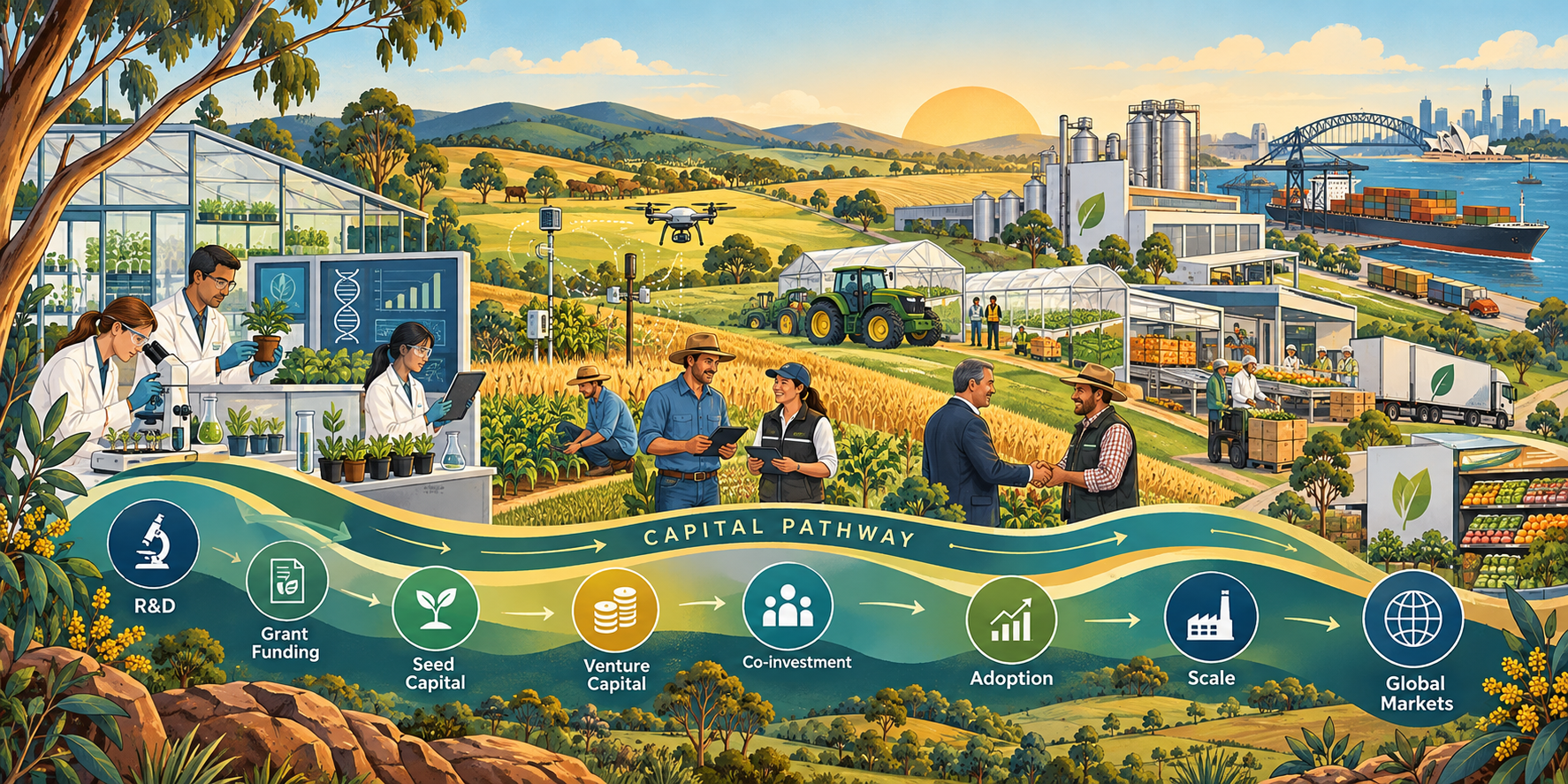
The report makes an important observation here. In the high-performing systems it examined, promising work is not left to navigate the transition from pilot to scale on its own. The next pathway, adoption, procurement, commercialisation, policy uptake or further co-investment, is considered deliberately.
So a useful question for the agrifood system is: once an opportunity moves beyond research, do we have a deliberate pathway through commercialisation, investment and adoption?
Different instruments for different jobs
The report does not argue specifically for venture capital. Recommendation 5 is broader: it calls for investment pathways capable of bringing together RDC, public, industry, private, corporate, concessional and adjacent-sector capital around shared outcomes. It also recommends co-investment pathways, blended capital and clear decision gates for continuing, redirecting, scaling or stopping investment. Venture capital is one instrument that can sit within that mix.
Research funding is particularly suited to knowledge creation, public-good research, technical validation and capability whose benefits may be broadly distributed across an industry.
Commercial capital has a different role. It becomes relevant where a solution is being developed through a scalable business, substantial further capital is required and commercial adoption matters alongside technical performance. Neither replaces the other.
Many opportunities will remain entirely research-led. Others may progress through licensing, grower adoption, procurement or corporate partnerships. For a narrower group, venture investment may provide a bridge between technical capability and a company capable of deploying that capability at scale.
That also means a dedicated venture capability will make sense for some RDCs and not others. Its relevance will depend on the size and quality of the opportunity set, how frequently sector priorities intersect with venture-backed technologies, whether commercial companies are an important route to adoption and whether external capital can meaningfully extend the resources directed toward those priorities.
Leverage, not simply investment
One of the more interesting ideas in the report is leverage. An RDC investment into a commercial opportunity can potentially do more than fund the company itself. It may help attract additional private capital, provide earlier access to strategically relevant technology and create a pathway through which successful solutions reach producers and value chains.
The report’s international evidence identifies institutionalised co-investment as a recurring characteristic of high-performing systems. Public and private capital are brought together through defined funding structures, selection criteria and portfolio discipline rather than being left to connect opportunistically.
This becomes particularly interesting where technologies cross commodity boundaries. A robotics platform may have applications across horticulture, grains and livestock. Water technologies, biologicals, energy systems, sensing, AI and traceability can address problems shared across several industries.
The report identifies fragmentation across portfolios and funding streams as one of the constraints on system performance. It therefore raises an interesting possibility: greater sharing of diligence, trials, commercial evidence or co-investment between RDCs where interests overlap, while each organisation retains its own mandate, governance and decision rights.
What RDCs bring that capital cannot
Capital alone does not create adoption. One of the report’s strongest findings is that adoption depends on trust, local legitimacy, peer networks, appropriate incentives and a clear pathway from engagement to implementation.
This is where RDCs bring something very different from a conventional financial investor. They have producer relationships, technical expertise, research and trial networks and a detailed understanding of how technologies interact with real production systems. Those capabilities help answer questions that ultimately determine whether a technology succeeds: does it solve a material industry problem? What evidence will users require? What prevents adoption? Do the economics work under Australian production conditions?
The opportunity is therefore not simply to connect RDC capital with companies. It is to connect industry knowledge, research capability, commercial expertise and external capital around technologies that have a credible pathway to impact.
Measuring what matters
That also changes how success might be assessed. A conventional venture fund is principally measured by financial performance. An RDC-backed commercialisation or investment program necessarily has a broader purpose.
Financial discipline remains important because it tests whether a business can attract customers, investment and ultimately become sustainable without continuing support. But that sits alongside the wider outcomes the report identifies: productivity, profitability, resilience, adoption and investment leverage.
Relevant measures might therefore include private capital attracted alongside RDC investment, strategically relevant technologies introduced into the sector, trials and commercial deployments completed, producer or value-chain adoption and, ultimately, measurable productivity or resilience outcomes. Existing RDC venture initiatives provide an opportunity to learn rather than a template that necessarily needs to be replicated.
The useful questions are what those programs tell us about leverage, access to technology, commercialisation, adoption and outcomes that would have been harder to achieve through other mechanisms. That evidence can then inform whether, and where, the approach has broader application.
From systems thinking to systems doing
The report closes with a call to move “from systems thinking to systems doing.” That feels like the right framing here as well. Venture capital is not an alternative to the RDC model, nor a judgement on the effectiveness of traditional R&D investment. It is one of several possible instruments available where innovation is being developed through companies and where private capital is required to reach commercial scale.
Perhaps the more useful question is therefore not “should an RDC have a venture fund?” It is: where do commercially scalable opportunities emerge within our innovation system, and do we have an effective pathway for them once they move beyond research? The report argues that Australia already possesses much of the capability required. Its central challenge is connecting that capability more deliberately.
Connecting capital to the research, industry knowledge and adoption pathways already present in the RDC system is one part of that broader opportunity. Done well, it can help more Australian innovation, and more useful innovation from elsewhere, find its way into farms, supply chains and new industries.
Disclosure: Artesian manages venture programs in partnership with some RDCs, so we have a perspective on this question. The issue is broader than any particular structure or provider, and we would be interested in how others across the RDC, research, industry and investment communities see it.